
Water, yes—but in moderation: improving yields in oranges
A recent installation of a 60 cm Sentek Drill & Drop™ probe, connected to a Compact system, laid the groundwork for marked improvements in the growing conditions of an orange grove. The farm is in Scanzano Jonico (MT), taken over in 2025 by Sherena’s agronomists, and grows oranges, particularly the Chislett and Navel Powell varieties. These are late varieties, harvested between February and March. The orchard is a little over ten years old—in its mature phase—with drip irrigation, 5 m × 4 m spacing, and a medium-texture red soil.
The main issue observed was significant fruit drop in June–July, following fruit set. The first strategy adopted was to limit nitrogen input, because previous experience showed that peaks in vegetative vigor increased fruit drop. In addition, there were clear irrigation inefficiencies: irrigation was carried out without a precise strategy and without measurement tools in the field. Previously, irrigation events were few and of long duration.
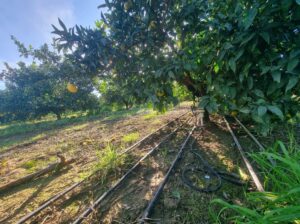
From the moment the probe was installed (see photo)—that is, when it became possible to understand how the plant behaved in terms of water uptake—the first consequence was a change in irrigation scheduling.
Irrigation events became more frequent and shorter in duration and volume, which helped contain vigor. This is crucial in months like June and July, when it is relatively easy to push the plant into stress not only due to water deficit but also due to over-irrigation, which causes a drastic drop in uptake and leads to fruit drop.
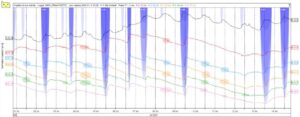
Below is a chart showing where the plant is absorbing (colored ovals) and the irrigation depth (vertical blue halos). In general, the goal is to deliver water to where the plant has active roots (in this case, down to 50–60 cm).
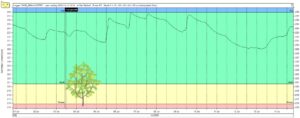
Below is the second graph used for interpreting the data: the stacked graph. The goal is to keep soil moisture within the green band, to avoid irrigating too much or too little.
The block was treated with various products, including biostimulants, to reduce stress, but without success. The key factors were changes in irrigation and nutrition management. As of today, the plant is healthy, with good vigor and reduced fruit drop.
There are no definitive yield data yet, but according to Sherena’s agronomists (our dealer in Southern Italy), there is a clear difference in yield potential compared to past years. We are talking about at least a 5-to-1 difference, because while this year each tree will very likely produce at least 50 kg, last year the average was around 10 kg.
This is another example of how a simple measurement tool, combined with agronomists’ know-how, can change the destiny of an orchard. In this case, decisions based on real data, the synergy between irrigation and nutrition, and continuous monitoring changed the course of the season, leaving the trees healthy and increasing yield.